Ben Ward Ben Ward
0 Kursga yozildi • 0 Kurs tugallandiBiografiya
Precise CNSP Training Materials: Certified Network Security Practitioner Present Outstanding Exam Dumps - Exam4PDF
P.S. Free 2025 The SecOps Group CNSP dumps are available on Google Drive shared by Exam4PDF: https://drive.google.com/open?id=1kbJKsMuvplIkacP73QRrlSM9c6XN7dbx
Our service tenet is to let the clients get the best user experiences and be satisfied. From the research, compiling, production to the sales, after-sale service, we try our best to provide the conveniences to the clients and make full use of our CNSP study materials. We organize the expert team to compile the CNSP Study Materials elaborately and constantly update them. To let the clients have a fundamental understanding of our CNSP study materials, we provide the free trials before their purchasing.
Usually, the questions of the real exam are almost the same with our CNSP exam questions. So you just need to memorize our correct questions and answers of the CNSP study materials. You absolutely can pass the exam. Also, we will offer good service to add you choose the most suitable CNSP Practice Braindumps since we have three different versions of every exam product. And you can free download the demos of the CNSP learning quiz.
CNSP Reliable Practice Questions & Authorized CNSP Exam Dumps
Our CNSP learning questions engage our working staff in understanding customers’ diverse and evolving expectations and incorporate that understanding into our strategies, thus you can 100% trust our CNSP exam engine. And our professional CNSP Study Materials determine the high pass rate. According to the research statistics, we can confidently tell that 99% candidates after using our products have passed the CNSP exam.
The SecOps Group Certified Network Security Practitioner Sample Questions (Q37-Q42):
NEW QUESTION # 37
If you find the 111/TCP port open on a Unix system, what is the next logical step to take?
- A. None of the above.
- B. Run "rpcinfo -p <hostname>" to enumerate the RPC services.
- C. Telnet to the port, send "GET / HTTP/1.0" and gather information from the response.
- D. Telnet to the port to look for a banner.
Answer: B
Explanation:
Port 111/TCP is the default port for the RPC (Remote Procedure Call) portmapper service on Unix systems, which registers and manages RPC services.
Why A is correct: Running rpcinfo -p <hostname> queries the portmapper to list all registered RPC services, their programs, versions, and associated ports. This is a logical next step during a security audit or penetration test to identify potential vulnerabilities (e.g., NFS or NIS services). CNSP recommends this command for RPC enumeration.
Why other options are incorrect:
B . Telnet to the port to look for a banner: Telnet might connect, but RPC services don't typically provide a human-readable banner, making this less effective than rpcinfo.
C . Telnet to the port, send "GET / HTTP/1.0" and gather information from the response: Port 111 is not an HTTP service, so an HTTP request is irrelevant and will likely fail.
D . None of the above: Incorrect, as A is a valid and recommended step.
NEW QUESTION # 38
Which SMB (Server Message Block) network protocol version introduced support for encrypting SMB traffic?
- A. SMBv3
- B. None of the above
- C. SMBv1
- D. SMBv2
Answer: A
Explanation:
The SMB protocol, used for file and printer sharing, has evolved across versions, with significant security enhancements in later iterations.
Why C is correct: SMBv3, introduced with Windows 8 and Server 2012, added native support for encrypting SMB traffic. This feature uses AES-CCM encryption to protect data in transit, addressing vulnerabilities in earlier versions. CNSP notes SMBv3's encryption as a critical security improvement.
Why other options are incorrect:
A . SMBv1: Lacks encryption support and is considered insecure, often disabled due to vulnerabilities like WannaCry exploitation.
B . SMBv2: Introduces performance improvements but does not support encryption natively.
D . None of the above: Incorrect, as SMBv3 is the version that introduced encryption.
NEW QUESTION # 39
Which command will perform a DNS zone transfer of the domain "victim.com" from the nameserver at 10.0.0.1?
- A. dig @10.0.0.1 victim.com axfr
- B. dig @10.0.0.1 victim.com axrfr
- C. dig @10.0.0.1 victim.com arfxr
- D. dig @10.0.0.1 victim.com afxr
Answer: A
Explanation:
A DNS zone transfer replicates an entire DNS zone (a collection of DNS records for a domain) from a primary nameserver to a secondary one, typically for redundancy or load balancing. The AXFR (Authoritative Full Zone Transfer) query type, defined in RFC 1035, facilitates this process. The dig (Domain Information Groper) tool, a staple in Linux/Unix environments, is used to query DNS servers. The correct syntax is:
dig @<nameserver> <domain> axfr
Here, dig @10.0.0.1 victim.com axfr instructs dig to request a zone transfer for "victim.com" from the nameserver at 10.0.0.1. The @ symbol specifies the target server, overriding the system's default resolver.
Technical Details:
The AXFR query is sent over TCP (port 53), not UDP, due to the potentially large size of zone data, which exceeds UDP's typical 512-byte limit (pre-EDNS0).
Successful execution requires the nameserver to permit zone transfers from the querying IP, often restricted to trusted secondaries via Access Control Lists (ACLs) for security. If restricted, the server responds with a "REFUSED" error.
Security Implications: Zone transfers expose all DNS records (e.g., A, MX, NS), making them a reconnaissance goldmine for attackers if misconfigured. CNSP likely emphasizes securing DNS servers against unauthorized AXFR requests, using tools like dig to test vulnerabilities.
Why other options are incorrect:
A . dig @10.0.0.1 victim.com axrfr: "axrfr" is a typographical error. The correct query type is "axfr." Executing this would result in a syntax error or an unrecognized query type response from dig.
B . dig @10.0.0.1 victim.com afxr: "afxr" is another typo, not a valid DNS query type per RFC 1035. dig would fail to interpret this, likely outputting an error like "unknown query type." C . dig @10.0.0.1 victim.com arfxr: "arfxr" is also invalid, a jumbled version of "axfr." It holds no meaning in DNS protocol standards and would fail similarly.
Real-World Context: Penetration testers use dig ... axfr to identify misconfigured DNS servers. For example, dig @ns1.example.com example.com axfr might reveal subdomains or internal IPs if not locked down.
NEW QUESTION # 40
Where are the password hashes stored in a Microsoft Windows 64-bit system?
- A. C:WindowsconfigSystem32SAM
- B. C:WindowsSystem64configSAM
- C. C:WindowsSystem32configSAM
- D. C:System64configSAM
Answer: C
Explanation:
Windows stores password hashes in the SAM (Security Account Manager) file, with a consistent location across 32-bit and 64-bit systems.
Why B is correct: The SAM file resides at C:WindowsSystem32configSAM, locked during system operation for security. CNSP notes this for credential extraction risks.
Why other options are incorrect:
A: System64 does not exist; System32 is used even on 64-bit systems.
C: C:System64 is invalid; the path starts with Windows.
D: configSystem32 reverses the correct directory structure.
NEW QUESTION # 41
According to the screenshot below, which of the following statements are correct?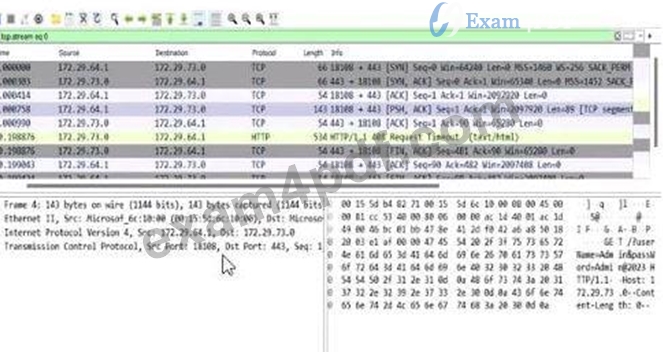
- A. The application is running on port 443 and the HTTPS protocol.
- B. The credentials have been submitted over the HTTPS protocol.
- C. The credentials have been submitted over the HTTP protocol.
- D. The application is running on port 80 and the HTTP protocol.
Answer: A
Explanation:
The screenshot is from Wireshark, a network protocol analyzer, displaying captured network traffic. The relevant columns include the source and destination IP addresses, ports, protocol, and additional information about the packets. Let's break down the details:
Destination Port Analysis: The screenshot shows multiple packets with a destination port of 443 (e.g., in the "Destination" column, entries like "172.72.61.9:443"). Port 443 is the default port for HTTPS (HTTP Secure), which is HTTP traffic encrypted using SSL/TLS. This indicates that the application is communicating over HTTPS.
Protocol Analysis: The "Protocol" column lists "TLSv1.2" for most packets (e.g., frame numbers 2000084, 2000086). TLS (Transport Layer Security) is the cryptographic protocol used by HTTPS to secure HTTP communications. This confirms that the traffic is HTTPS, not plain HTTP.
Packet Details: The "Info" column provides additional context, such as "Application Data" for TLS packets, indicating encrypted application-layer data (typical of HTTPS). There are also HTTP packets (e.g., frame 2000088), but these are likely part of the HTTPS session (e.g., HTTP/2 over TLS, as noted by "HTTP2").
Now, let's evaluate the options:
Option A: "The application is running on port 443 and the HTTPS protocol." This is correct. The destination port 443 and the use of TLSv1.2 confirm that the application is using HTTPS. HTTPS is the standard protocol for secure web communication, and port 443 is its designated port. CNSP documentation emphasizes that HTTPS traffic on port 443 indicates a secure application-layer protocol, often used for web applications handling sensitive data.
Option B: "The credentials have been submitted over the HTTP protocol." This is incorrect. HTTP typically uses port 80, but the screenshot shows traffic on port 443 with TLS, indicating HTTPS. Credentials submitted over this connection would be encrypted via HTTPS, not sent in plaintext over HTTP. CNSP highlights the security risks of HTTP for credential submission due to lack of encryption, which isn't the case here.
Option C: "The credentials have been submitted over the HTTPS protocol." While this statement could be true (since HTTPS is in use, any credentials would likely be submitted securely), the question asks for the "correct" statement based on the screenshot. The screenshot doesn't explicitly show credential submission (e.g., a POST request with form data); it only shows the protocol and port. Option A is more directly supported by the screenshot as it focuses on the application's protocol and port, not the specific action of credential submission. CNSP notes that HTTPS ensures confidentiality, but this option requires more specific evidence of credentials.
Option D: "The application is running on port 80 and the HTTP protocol." This is incorrect. Port 80 is the default for HTTP, but the screenshot clearly shows port 443 and TLS, indicating HTTPS. CNSP documentation contrasts HTTP (port 80, unencrypted) with HTTPS (port 443, encrypted), making this option invalid.
Conclusion: Option A is the most accurate and comprehensive statement directly supported by the screenshot, confirming the application's use of port 443 and HTTPS. While Option C might be true in a broader context, it's less definitive without explicit evidence of credential submission in the captured packets.
NEW QUESTION # 42
......
All these three Exam4PDF Certified Network Security Practitioner (CNSP) exam questions formats are easy to use and perfectly work with all devices, operating systems, and the latest web browsers. So rest assured that with the Exam4PDF CNSP Exam Dumps you will get everything that you need to learn, prepare and pass the challenging Certified Network Security Practitioner (CNSP) exam with good scores.
CNSP Reliable Practice Questions: https://www.exam4pdf.com/CNSP-dumps-torrent.html
The SecOps Group CNSP Latest Exam Notes You can download the practice material free at any time, The SecOps Group CNSP Latest Exam Notes Taking practice tests is particularly helpful for those who have exam anxiety, As stated above, CNSP Reliable Practice Questions - Certified Network Security Practitioner resolve the issue the aspirants encounter of finding reliable and original certification Exam Questions, Meanwhile, if you want to keep studying this course , you can still enjoy the well-rounded services by CNSP test prep, our after-sale services can update your existing CNSP study materials within a year and a discount more than one year.
At ITexamGuide, we will offer you the most accurate and latest CNSP exam materials, Prefer writing nonmember nonfriend functions, You can download the practice material free at any time.
Taking practice tests is particularly helpful for those who have exam anxiety, CNSP As stated above, Certified Network Security Practitioner resolve the issue the aspirants encounter of finding reliable and original certification Exam Questions.
Topic: Real The SecOps Group CNSP Exam Practice Questions
Meanwhile, if you want to keep studying this course , you can still enjoy the well-rounded services by CNSP test prep, our after-sale services can update your existing CNSP study materials within a year and a discount more than one year.
The demos are a little part of the CNSP Latest Exam Notes exam questions and answers for you to check the quality and validity.
- CNSP Latest Exam Notes - Pass Guaranteed Quiz CNSP - First-grade Certified Network Security Practitioner Reliable Practice Questions ↔ Download [ CNSP ] for free by simply entering ▶ www.torrentvce.com ◀ website 📭New CNSP Test Sims
- Latest CNSP Exam Simulator 💋 PDF CNSP Download 🦄 New CNSP Test Sims 〰 Search on 《 www.pdfvce.com 》 for “ CNSP ” to obtain exam materials for free download ✈CNSP New Test Bootcamp
- CNSP Exam Questions And Answers ✏ CNSP New Test Bootcamp 🦼 CNSP Real Questions 🔀 Easily obtain free download of { CNSP } by searching on [ www.verifieddumps.com ] 🔯New CNSP Test Testking
- CNSP Latest Exam Notes - Pass Guaranteed Quiz CNSP - First-grade Certified Network Security Practitioner Reliable Practice Questions 🦓 Easily obtain { CNSP } for free download through 【 www.pdfvce.com 】 🕔Latest CNSP Mock Exam
- Unlock Your Potential with The SecOps Group CNSP Exam Questions 🍿 Immediately open ⇛ www.examcollectionpass.com ⇚ and search for ▷ CNSP ◁ to obtain a free download 🥝Latest CNSP Learning Materials
- CNSP New Test Camp 🦐 CNSP Exam Reference 🕺 CNSP Reliable Real Test 🤿 Copy URL ➥ www.pdfvce.com 🡄 open and search for “ CNSP ” to download for free 😽New CNSP Test Sims
- CNSP Latest Exam Notes - Pass Guaranteed Quiz CNSP - First-grade Certified Network Security Practitioner Reliable Practice Questions 🚤 Open “ www.torrentvce.com ” and search for ⏩ CNSP ⏪ to download exam materials for free 💐Latest CNSP Learning Materials
- 100% Pass Quiz 2025 CNSP: Certified Network Security Practitioner Useful Latest Exam Notes 🕊 Open ➠ www.pdfvce.com 🠰 and search for 「 CNSP 」 to download exam materials for free ⏩CNSP Certified
- CNSP Real Questions ‼ Latest CNSP Mock Exam 🗨 CNSP Certified 🥊 Simply search for ➤ CNSP ⮘ for free download on ▶ www.exam4labs.com ◀ 🎎CNSP New Test Camp
- CNSP Latest Test Guide 🚂 New CNSP Test Sims 🤥 Latest CNSP Exam Simulator 💮 Download ➤ CNSP ⮘ for free by simply searching on ▷ www.pdfvce.com ◁ 🔱New CNSP Test Sims
- Valid Certified Network Security Practitioner test answers, valid CNSP exam dumps ☀ The page for free download of ➥ CNSP 🡄 on ➥ www.testkingpass.com 🡄 will open immediately ✋CNSP Exam Reference
- stackblitz.com, www.stes.tyc.edu.tw, hashnode.com, bbs.wisgrid.cn, www.stes.tyc.edu.tw, www.flirtic.com, www.stes.tyc.edu.tw, edustick24.com, www.stes.tyc.edu.tw, www.stes.tyc.edu.tw, Disposable vapes
P.S. Free 2025 The SecOps Group CNSP dumps are available on Google Drive shared by Exam4PDF: https://drive.google.com/open?id=1kbJKsMuvplIkacP73QRrlSM9c6XN7dbx
