Jay Bell Jay Bell
0 Kursga yozildi • 0 Kurs tugallandiBiografiya
Linux Foundation CKS Latest Test Questions - Valid CKS Test Practice
BONUS!!! Download part of Test4Engine CKS dumps for free: https://drive.google.com/open?id=10IrH6plWw87leM7T_yNA7LvhTpvHzLxu
Just choose the right Linux Foundation CKS exam questions format demo and download it quickly. Download the Test4Engine Linux Foundation CKS exam questions demo now and check the top features of Test4Engine Linux Foundation CKS Exam Questions. If you think the Test4Engine Linux Foundation CKS exam dumps can work for you then take your buying decision. Best of luck in exams and career!!!
The CKS Certification Exam is an industry-recognized certification that is highly valued by employers. It is a way for professionals to demonstrate their expertise in securing Kubernetes deployments and their commitment to staying up-to-date with the latest security best practices. Certified Kubernetes Security Specialist (CKS) certification is also a way for organizations to identify qualified professionals who can help them secure their Kubernetes clusters and protect their sensitive data.
>> Linux Foundation CKS Latest Test Questions <<
Valid CKS Test Practice & CKS Instant Download
Three versions for CKS training materials are available, you can choose one you like according to your own needs. All three versions have free demo for you to have a try. CKS PDF version is printable and you can learn them anytime and anyplace. CKS Soft test engine can stimulate the real exam environment, so that you can know the procedures for the exam, and your confidence for CKS Exam Materials will also be improved. CKS Online test engine is convenient and easy to learn, it has testing history and performance review, and you can have a general review of what you have learned by this version.
Linux Foundation Certified Kubernetes Security Specialist (CKS) Sample Questions (Q93-Q98):
NEW QUESTION # 93
Your Kubernetes cluster iS running a web application that requires access to a database hosted on an external Cloud provider. Describe how you can secure the connection between the application and the database using TLS/SSL encryption and identity-based authentication.
Answer:
Explanation:
Solution (Step by Step) :
1. Configure TLS/SSL Encryption:
- Generate Certificate: Obtain a TLS/SSL certificate from a trusted certificate authority (CA) or use a self-signed certificate for development purposes-
- Install Certificate on Database Server: Install the certificate on the database server, making it available to the database service.
- Configure Database Service: Configure the database service to accept connections only over TLS/SSL.
- Configure Application Container:
- Mount Certificate: Mount the TLS/SSL certificate into the application container as a secret.
- Configure Application Code: Update the application code to use the certificate when connecting to the database.
2. Implement Identity-Based Authentication:
- Create Database User: Create a dedicated database user specifically for the web application.
- Grant Permissions: Grant appropriate permissions to the database user, limiting access to the necessary tables and data.
- Use Authentication Plugin: Configure the database service to use an authentication plugin that supports identity-based authentication.
- Generate Database Credentials: Generate database credentials (usemame and password) for the application.
- Store Credentials Secretly: Store the database credentials securely as a Kubernetes secret.
- Access Credentials from Application: Configure the application to access the database credentials from the secret.
3. Connect Application to Database:
- Configure Connection String: Update the application's connection string to use TLS/SSL and the database user credentials.
- Example Connection String:
jdbc:postgresql://database-host:5432/database-name?ssl=true&sslmode=require&user=app user&password=app-password
4. Security Considerations:
- Certificate Validation: Ensure the certificate is validated by the application to prevent man-in-the-middle attacks.
- Secure Credential Management: Implement strong security measures to protect the database credentials stored as secrets.
- Access Control: Limit access to the database to only authorized users and applications.
- Network Isolatiom Consider using network policies to isolate the web application from other workloads and restrict unnecessary network traffic.
NEW QUESTION # 94
Cluster: scanner Master node: controlplane Worker node: worker1
You can switch the cluster/configuration context using the following command:
[desk@cli] $ kubectl config use-context scanner
Given: You may use Trivy's documentation.
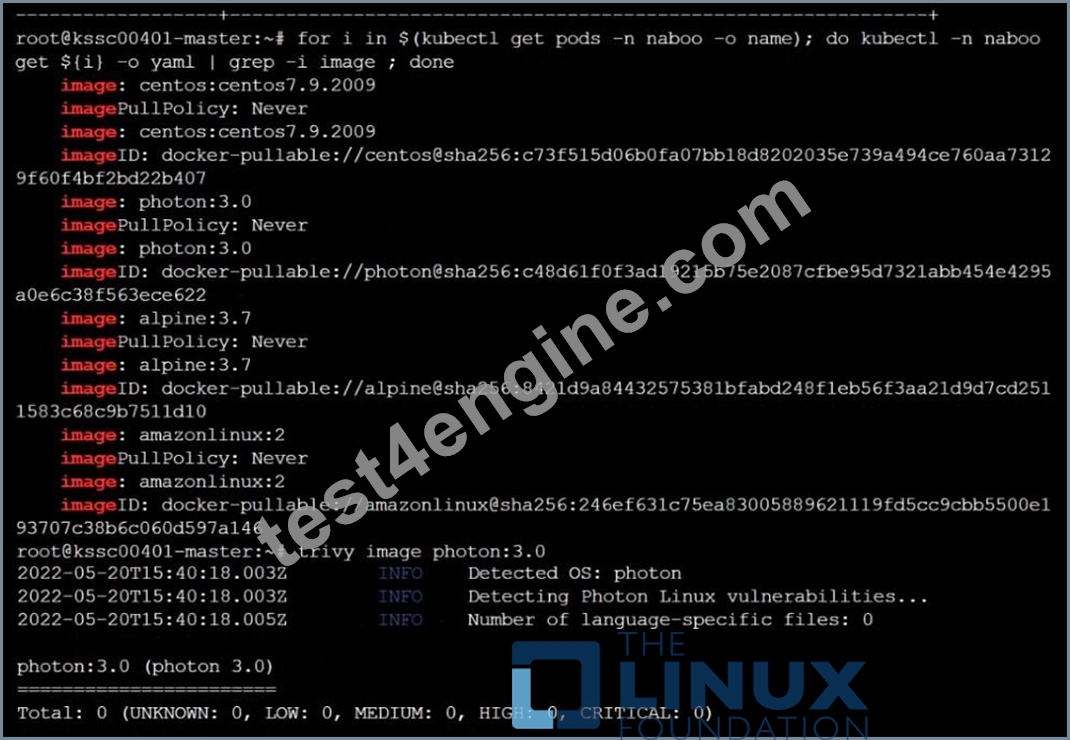
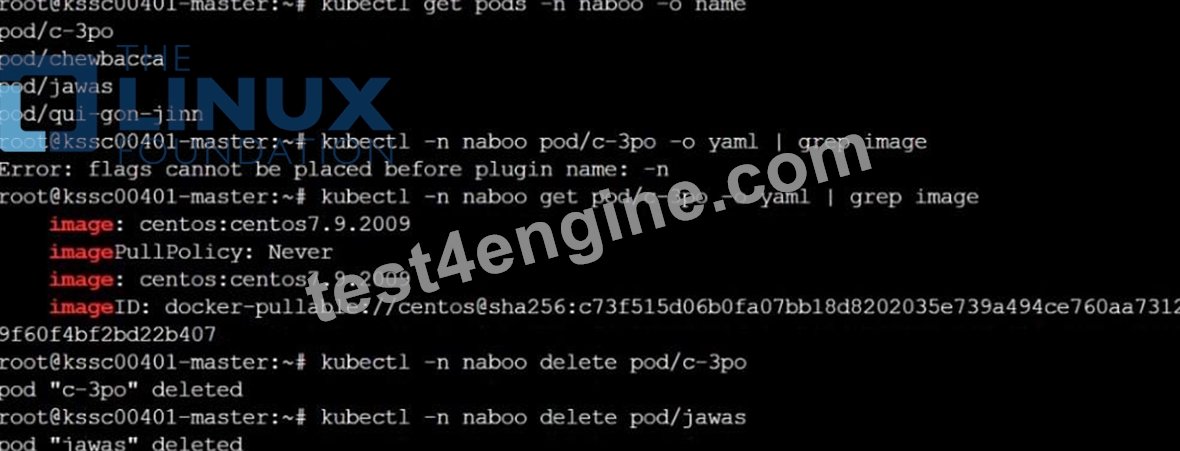
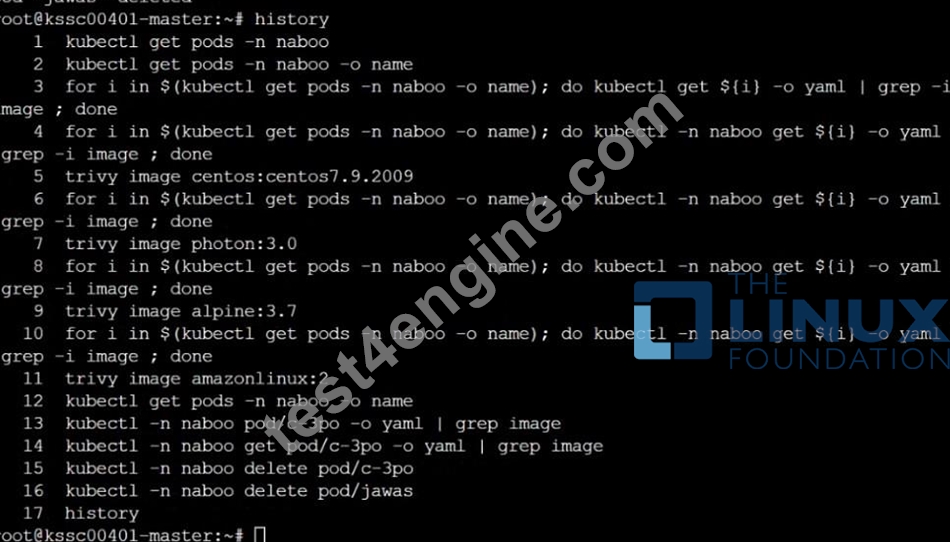
Task: Use the Trivy open-source container scanner to detect images with severe vulnerabilities used by Pods in the namespace nato.
Look for images with High or Critical severity vulnerabilities and delete the Pods that use those images. Trivy is pre-installed on the cluster's master node. Use cluster's master node to use Trivy.
Answer:
Explanation: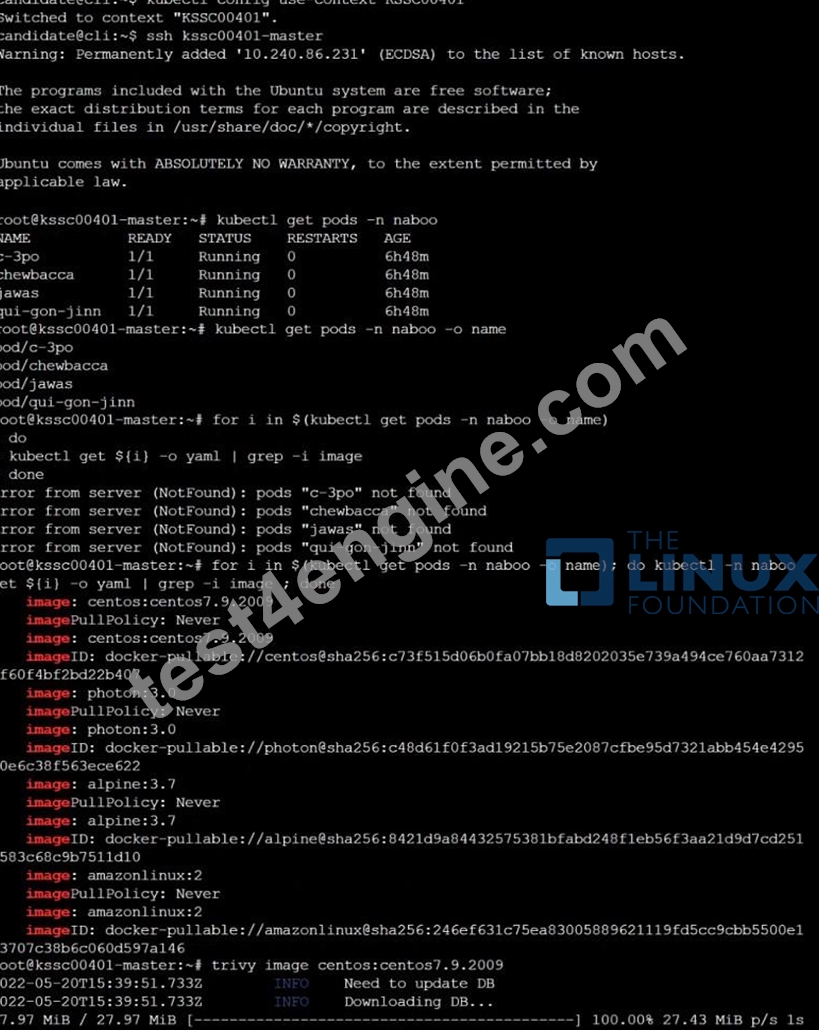
NEW QUESTION # 95
Fix all issues via configuration and restart the affected components to ensure the new setting takes effect.
Fix all of the following violations that were found against the API server:- a. Ensure the --authorization-mode argument includes RBAC b. Ensure the --authorization-mode argument includes Node c. Ensure that the --profiling argument is set to false Fix all of the following violations that were found against the Kubelet:- a. Ensure the --anonymous-auth argument is set to false.
b. Ensure that the --authorization-mode argument is set to Webhook.
Fix all of the following violations that were found against the ETCD:-
a. Ensure that the --auto-tls argument is not set to true
Hint: Take the use of Tool Kube-Bench
Answer:
Explanation:
API server:
Ensure the --authorization-mode argument includes RBAC
Turn on Role Based Access Control. Role Based Access Control (RBAC) allows fine-grained control over the operations that different entities can perform on different objects in the cluster. It is recommended to use the RBAC authorization mode.
Fix - Buildtime
Kubernetes
apiVersion: v1
kind: Pod
metadata:
creationTimestamp: null
labels:
component: kube-apiserver
tier: control-plane
name: kube-apiserver
namespace: kube-system
spec:
containers:
- command:
+ - kube-apiserver
+ - --authorization-mode=RBAC,Node
image: gcr.io/google_containers/kube-apiserver-amd64:v1.6.0
livenessProbe:
failureThreshold: 8
httpGet:
host: 127.0.0.1
path: /healthz
port: 6443
scheme: HTTPS
initialDelaySeconds: 15
timeoutSeconds: 15
name: kube-apiserver-should-pass
resources:
requests:
cpu: 250m
volumeMounts:
- mountPath: /etc/kubernetes/
name: k8s
readOnly: true
- mountPath: /etc/ssl/certs
name: certs
- mountPath: /etc/pki
name: pki
hostNetwork: true
volumes:
- hostPath:
path: /etc/kubernetes
name: k8s
- hostPath:
path: /etc/ssl/certs
name: certs
- hostPath:
path: /etc/pki
name: pki
Ensure the --authorization-mode argument includes Node
Remediation: Edit the API server pod specification file /etc/kubernetes/manifests/kube-apiserver.yaml on the master node and set the --authorization-mode parameter to a value that includes Node.
--authorization-mode=Node,RBAC
Audit:
/bin/ps -ef | grep kube-apiserver | grep -v grep
Expected result:
'Node,RBAC' has 'Node'
Ensure that the --profiling argument is set to false
Remediation: Edit the API server pod specification file /etc/kubernetes/manifests/kube-apiserver.yaml on the master node and set the below parameter.
--profiling=false
Audit:
/bin/ps -ef | grep kube-apiserver | grep -v grep
Expected result:
'false' is equal to 'false'
Fix all of the following violations that were found against the Kubelet:- Ensure the --anonymous-auth argument is set to false.
Remediation: If using a Kubelet config file, edit the file to set authentication: anonymous: enabled to false. If using executable arguments, edit the kubelet service file /etc/systemd/system/kubelet.service.d/10-kubeadm.conf on each worker node and set the below parameter in KUBELET_SYSTEM_PODS_ARGS variable.
--anonymous-auth=false
Based on your system, restart the kubelet service. For example:
systemctl daemon-reload
systemctl restart kubelet.service
Audit:
/bin/ps -fC kubelet
Audit Config:
/bin/cat /var/lib/kubelet/config.yaml
Expected result:
'false' is equal to 'false'
2) Ensure that the --authorization-mode argument is set to Webhook.
Audit
docker inspect kubelet | jq -e '.[0].Args[] | match("--authorization-mode=Webhook").string' Returned Value: --authorization-mode=Webhook Fix all of the following violations that were found against the ETCD:- a. Ensure that the --auto-tls argument is not set to true Do not use self-signed certificates for TLS. etcd is a highly-available key value store used by Kubernetes deployments for persistent storage of all of its REST API objects. These objects are sensitive in nature and should not be available to unauthenticated clients. You should enable the client authentication via valid certificates to secure the access to the etcd service.
Fix - Buildtime
Kubernetes
apiVersion: v1
kind: Pod
metadata:
annotations:
scheduler.alpha.kubernetes.io/critical-pod: ""
creationTimestamp: null
labels:
component: etcd
tier: control-plane
name: etcd
namespace: kube-system
spec:
containers:
- command:
+ - etcd
+ - --auto-tls=true
image: k8s.gcr.io/etcd-amd64:3.2.18
imagePullPolicy: IfNotPresent
livenessProbe:
exec:
command:
- /bin/sh
- -ec
- ETCDCTL_API=3 etcdctl --endpoints=https://[192.168.22.9]:2379 --cacert=/etc/kubernetes/pki/etcd/ca.crt
--cert=/etc/kubernetes/pki/etcd/healthcheck-client.crt --key=/etc/kubernetes/pki/etcd/healthcheck-client.key get foo failureThreshold: 8 initialDelaySeconds: 15 timeoutSeconds: 15 name: etcd-should-fail resources: {} volumeMounts:
- mountPath: /var/lib/etcd
name: etcd-data
- mountPath: /etc/kubernetes/pki/etcd
name: etcd-certs
hostNetwork: true
priorityClassName: system-cluster-critical
volumes:
- hostPath:
path: /var/lib/etcd
type: DirectoryOrCreate
name: etcd-data
- hostPath:
path: /etc/kubernetes/pki/etcd
type: DirectoryOrCreate
name: etcd-certs
status: {}
NEW QUESTION # 96
Create a new NetworkPolicy named deny-all in the namespace testing which denies all traffic of type ingress and egress traffic
Answer:
Explanation:
You can create a "default" isolation policy for a namespace by creating a NetworkPolicy that selects all pods but does not allow any ingress traffic to those pods.
---
apiVersion: networking.k8s.io/v1
kind: NetworkPolicy
metadata:
name: default-deny-ingress
spec:
podSelector: {}
policyTypes:
- Ingress
You can create a "default" egress isolation policy for a namespace by creating a NetworkPolicy that selects all pods but does not allow any egress traffic from those pods.
---
apiVersion: networking.k8s.io/v1
kind: NetworkPolicy
metadata:
name: allow-all-egress
spec:
podSelector: {}
egress:
- {}
policyTypes:
- Egress
Default deny all ingress and all egress traffic
You can create a "default" policy for a namespace which prevents all ingress AND egress traffic by creating the following NetworkPolicy in that namespace.
---
apiVersion: networking.k8s.io/v1
kind: NetworkPolicy
metadata:
name: default-deny-all
spec:
podSelector: {}
policyTypes:
- Ingress
- Egress
This ensures that even pods that aren't selected by any other NetworkPolicy will not be allowed ingress or egress traffic.
NEW QUESTION # 97
Context: Cluster: gvisor Master node: master1 Worker node: worker1
You can switch the cluster/configuration context using the following command:
[desk@cli] $ kubectl config use-context gvisor
Context: This cluster has been prepared to support runtime handler, runsc as well as traditional one.
Task: Create a RuntimeClass named not-trusted using the prepared runtime handler names runsc. Update all Pods in the namespace server to run on newruntime.
Answer:
Explanation: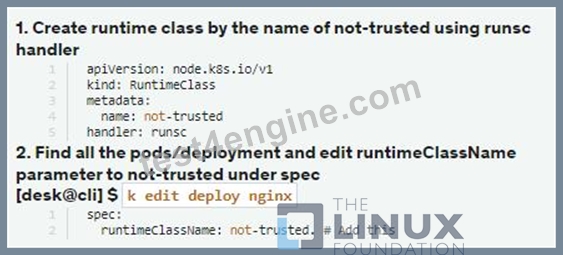
Explanation
[desk@cli] $vim runtime.yaml
apiVersion: node.k8s.io/v1
kind: RuntimeClass
metadata:
name: not-trusted
handler: runsc
[desk@cli] $ k apply -f runtime.yaml [desk@cli] $ k get pods
NAME READY STATUS RESTARTS AGE
nginx-6798fc88e8-chp6r 1/1 Running 0 11m
nginx-6798fc88e8-fs53n 1/1 Running 0 11m
nginx-6798fc88e8-ndved 1/1 Running 0 11m
[desk@cli] $ k get deploy
NAME READY UP-TO-DATE AVAILABLE AGE
nginx 3/3 11 3 5m
[desk@cli] $ k edit deploy nginx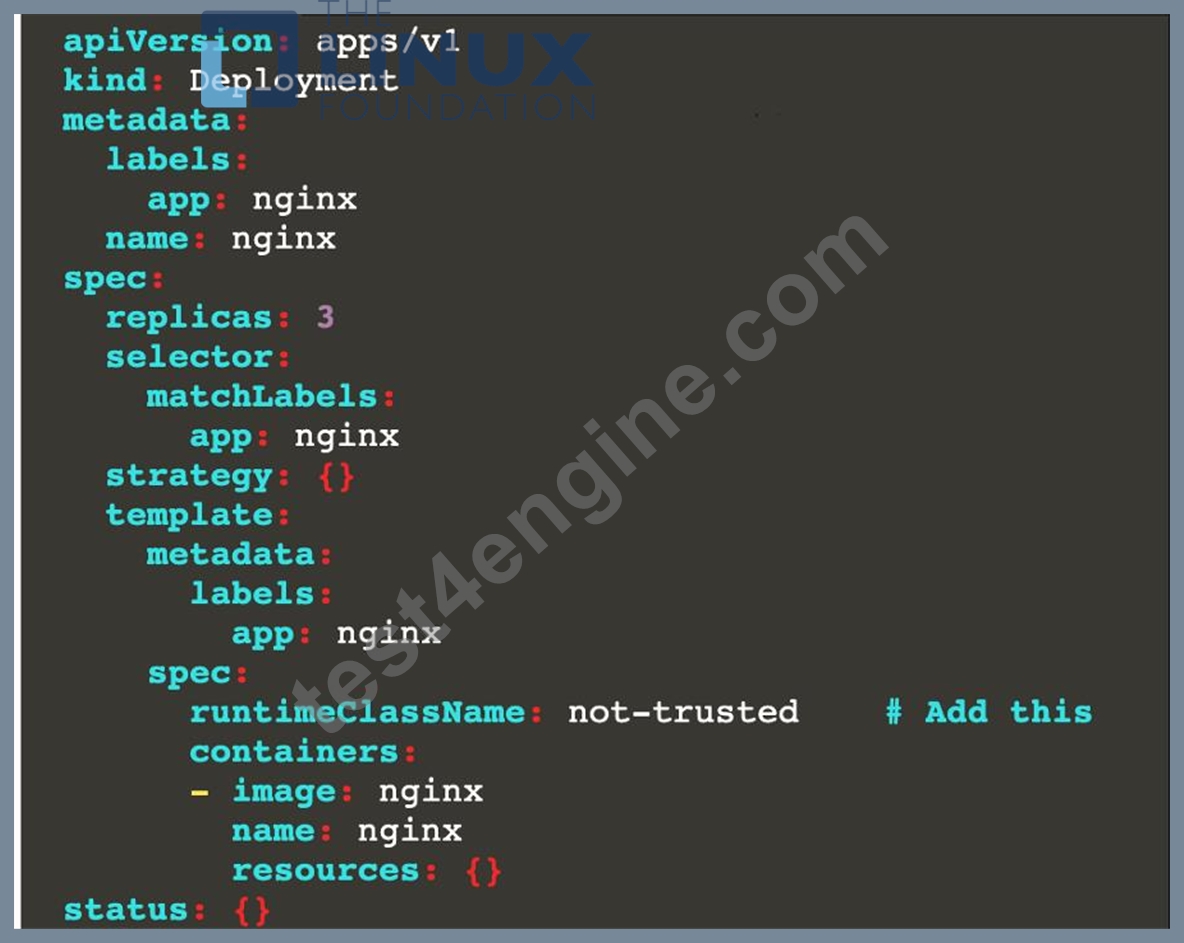
NEW QUESTION # 98
......
Maybe though you believe that our our CKS exam questions are quite good, you still worry that the pass rate. Then the data may make you more at ease. The passing rate of CKS preparation prep reached 99%, which is a very incredible value, but we did. If you want to know more about our products, you can consult our staff, or you can download our free trial version of our CKS Practice Engine. We are looking forward to your joining.
Valid CKS Test Practice: https://www.test4engine.com/CKS_exam-latest-braindumps.html
- CKS Exam Revision Plan 🍨 Test CKS Objectives Pdf 🗽 CKS Exam Revision Plan 🏙 Open website ➥ www.lead1pass.com 🡄 and search for ☀ CKS ️☀️ for free download 🔫Brain CKS Exam
- CKS Accurate Study Material ⛅ Exam CKS Quick Prep 🦽 CKS Accurate Study Material 🗨 Search for ➠ CKS 🠰 and easily obtain a free download on ➠ www.pdfvce.com 🠰 🍲Test CKS Objectives Pdf
- Pass Guaranteed Quiz 2025 Linux Foundation Updated CKS Latest Test Questions 😉 Download ➡ CKS ️⬅️ for free by simply entering 「 www.testkingpdf.com 」 website 🌑Reliable CKS Exam Dumps
- Exam CKS Revision Plan 👑 Exam CKS Quick Prep 🐆 CKS Reliable Test Price 🙁 Search for ⏩ CKS ⏪ and download it for free immediately on ( www.pdfvce.com ) 🐑Reliable CKS Exam Dumps
- Updated Linux Foundation CKS Questions To Clear CKS Exam 🦲 Search for ⇛ CKS ⇚ and download it for free immediately on ✔ www.examsreviews.com ️✔️ ✴Examcollection CKS Dumps Torrent
- Fully Updated Linux Foundation CKS Dumps With Latest CKS Exam Questions [2025] 🎸 Open [ www.pdfvce.com ] enter ➽ CKS 🢪 and obtain a free download 🎆Real CKS Exams
- Real CKS Exams 🐳 Brain CKS Exam 🌞 Valid Dumps CKS Files 🥌 Search for ➤ CKS ⮘ on [ www.testsimulate.com ] immediately to obtain a free download 🔧CKS Latest Exam Discount
- Pass Guaranteed Quiz 2025 Linux Foundation Updated CKS Latest Test Questions 💌 Search for ➥ CKS 🡄 and download exam materials for free through ✔ www.pdfvce.com ️✔️ 🚝Latest Test CKS Discount
- With Linux Foundation CKS Real Questions Nothing Can Stop You from Getting Success ☢ ⏩ www.dumps4pdf.com ⏪ is best website to obtain 【 CKS 】 for free download 🥵CKS Actual Dump
- Pass Guaranteed Quiz 2025 Linux Foundation Updated CKS Latest Test Questions ✔️ Search for ☀ CKS ️☀️ and download exam materials for free through 「 www.pdfvce.com 」 🟠Examcollection CKS Dumps Torrent
- Valid Exam CKS Preparation 🌞 CKS Accurate Study Material 💞 New CKS Exam Price ⛴ Enter ⏩ www.real4dumps.com ⏪ and search for ➥ CKS 🡄 to download for free 🌅CKS Brain Dumps
- ncon.edu.sa, gesapuntesacademia.es, www.stes.tyc.edu.tw, learning.cynaris.click, elearning.omegasystems.gr, daotao.wisebusiness.edu.vn, motionentrance.edu.np, myportal.utt.edu.tt, myportal.utt.edu.tt, myportal.utt.edu.tt, myportal.utt.edu.tt, myportal.utt.edu.tt, myportal.utt.edu.tt, myportal.utt.edu.tt, myportal.utt.edu.tt, myportal.utt.edu.tt, myportal.utt.edu.tt, www.stes.tyc.edu.tw, shortcourses.russellcollege.edu.au, Disposable vapes
2025 Latest Test4Engine CKS PDF Dumps and CKS Exam Engine Free Share: https://drive.google.com/open?id=10IrH6plWw87leM7T_yNA7LvhTpvHzLxu
